Speech-to-Song Illusion Project
Can speech ever sound like song?
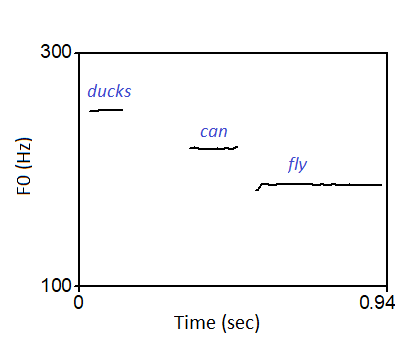
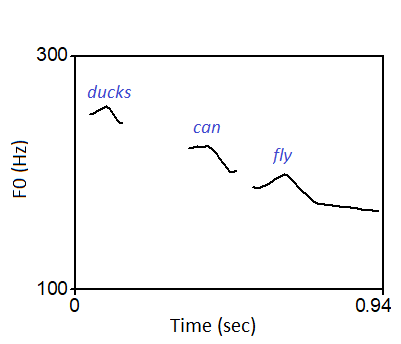
Seemingly impossible, the “Speech-to-Song illusion” (S2S) is a striking example of a perceptual transformation effect where a spoken phrase repeated several times shifts to being heard as sung without any change to the speech sounds. Our previous work revealed that sound acoustics play a crucial role in S2S. While the acoustic shape of the spoken phrase has to remain unchanged during repetitions, some pitch and timing properties of the phrase are more supportive of the perceptual transformation than other. For example, compare tracks of the fundamental frequency on the left (flat) and on the right (dynamic). They both show the same spoken phrase, “Ducks can fly”. However, the phrase on the left is likely to transform into song quicker and easier for most people.
Listen: “Ducks can fly”
The same phrase with a flat and with a dynamic pitch track. Switch on repeat and listen to each one several times in a row.
History
S2S was coined by the psychologist Diana Deutsch who included a looped phrase “but they sometimes behave so strangely” on her CD, “Phantom Words and Other Curiosities” (published in 2003). Although this phenomenon has been well known to musicians for a long time (cf. works by Steve Reich and others), it has started to attract researchers’ attention over the last decade, with recent publications from linguistics and psychology increasing in numbers.
The project
Most listeners, regardless of their musical skills and training, are likely to experience a transformation from speech to song during the third repetition of the phrase. There is, however, a lot of individual variability in S2S. Some people never perceive song after listening to a loop, some people always do. Our project examines the role of the individual perceiver in S2S, and studies which characteristics may predict listeners’ experience.
Research team
We have been fascinated by this speech-to-song effect for a long time. Our team combines the expertise from music psychology (Prof Simone Dalla Bella), neurolinguistics (Prof Simone Falk) and speech prosody (Prof. Dr. Tamara Rathcke).

The project was supported by a BA/Leverhulme Small Research Grant to Prof. Dr. Tamara Rathcke (SG152108).
Publications
- Rathcke, T.V., & Canzi, M. (2026). Individual differences in musical melody perception moderate the speech-to-song illusion in Mandarin Chinese listeners. Scientific Reports 16, 10523.
- Rathcke, T., & Smit, E. A. (2025). Musical aptitude moderates ease and vividness but not frequency of the speech-to-song illusion. Scientific Reports, 15, 33315.
- Rathcke, T., Falk, S., Dalla Bella, S. (2024). Why does speech sometimes sound like song? Exploring the role of music-related priors in the speech-to-song illusion. Music & Science.
- Smit, E., Rathcke, T. (2024). Beyond musical training: Individual influences on the perception of the speech-to-song illusion. Psychology of Music, 03057356241256652.
- Rathcke, T., Falk, S., Dalla Bella, S. (2021). Music to Your Ears: Sentence Sonority and Listener Background Modulate the “Speech-to-Song Illusion”. Music Perception (2021) 38 (5): 499-508.
- Falk, Simone, Rathcke, Tamara V, Dalla Bella, Simone (2014) When Speech Sounds Like Music. Journal of Experimental Psychology: Human Perception and Performance, 40 (4). pp. 1491-1506. ISSN 0096-1523. (doi:10.1037/a0036858)
- Falk, Simone and Rathcke, Tamara V (2011) The Speech-To-Song Illusion Revisited. In: Debowska-Kozłowska, Kamila and Dziubalska-Kołaczyk, Katarzyna, eds. On Words and Sounds. Cambridge Scholars Publishing, Cambridge, pp. 1-26. ISBN 1-4438-3161-1.
- Falk, Simone, Rathcke, Tamara V (2010) On the Speech-To-Song Illusion: Evidence from German. In: Proceedings of the 5th Conference on Speech Prosody.
Conference presentations
- Rathcke T., Falk S., Dalla Bella S. (2018). Phonological structure and listener characteristics modulate the “speech-to-song illusion”. Poster presented at the 16th Conference on Laboratory Phonology, Universidade de Lisboa, Portugal, June 2018.
- Rathcke T., Falk S., Dalla Bella S. (2018). Linguistic structure and listener characteristics modulate the “speech-to-song illusion”. Paper presented at the 15th International Conference on Music Perception and Cognition, Montreal, July 2018.
- Rathcke T., Falk S., Dalla Bella S. (2019). Facilitators of the “speech-to-song illusion”. Paper presented at the 41st Conference of the German Linguistics Society. University of Bremen, Germany, March 2019.
S2S database
In this project, we have created a database containing 60 sentences in two prosodically dissimilar languages, English and French. The sentences were produced by a male and female speaker in each language, and looped with 10 repetitions following the design of our previous studies. 120 out of 240 stimuli that we created, have been rated for their S2S-susceptibility by 40 native listeners in each language. This resource will soon be freely available to all interested researchers.
Here are examples of a high-transforming and a low-transforming sentence in each language. You can listen to the sentences looped, and see if you perceive the effect.
| Recording | High-transforming | Low-transforming |
|---|---|---|
| English, single | ||
| English, looped | ||
| French, single | ||
| French, looped |
To register your interest in using S2S database, please contact Prof. Dr. Tamara Rathcke.